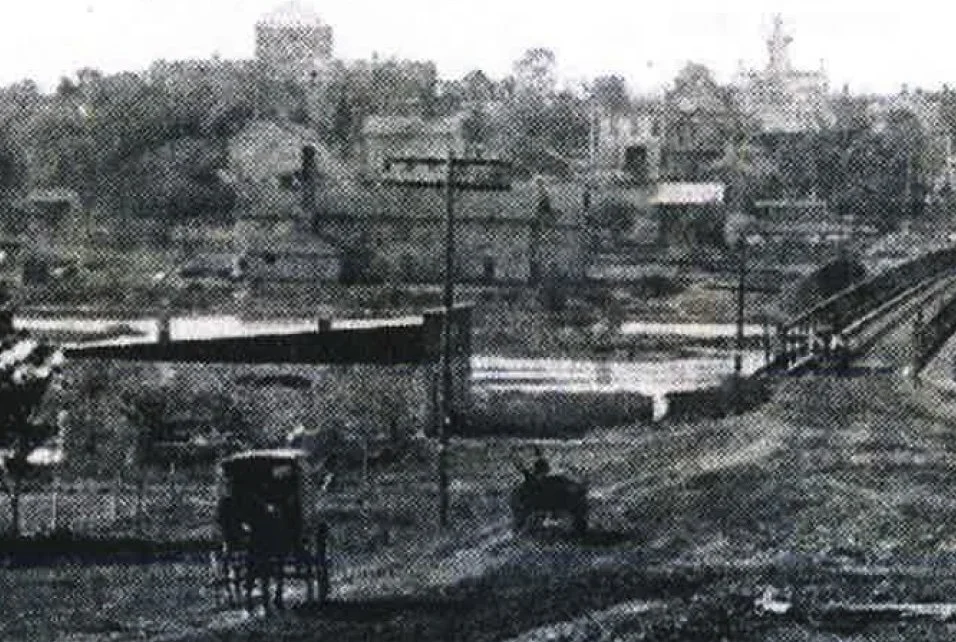

HISTORY
A History of Geneva's 1845 Blacksmith Shop
— and Why It Matters
Most everyone knew that the blacksmith shop was there. Yet no one had seen it for decades.
For many in the Geneva community, the existence of the Alexander brothers’ blacksmith shop seemed more legend than real. But its reality was confirmed when a demolition crew cleaved away a restaurant’s dining rooms, kitchen, and lobby to reveal the limestone walls of a shop that most people alive that day had never seen.
The city, about 40 miles west of Chicago, had approved tearing down the restaurant that had served diners for nearly eight decades because repair of the building would be costly, and it had stood vacant for a half-dozen years. However, the demolition permit was conditional. The owner was required to spare an historic building that records said was encased inside.
For months, local citizens were in suspense about the size, appearance, and condition of the embedded building. As a demolition crew cleared away debris, passing vehicles slowed for drivers and passengers to take a look, and pedestrians stopped at the barrier fence to gaze at a structure that hadn’t been visible since before most of them were born.
The revealed shop was a remnant of the town’s early settlement days. Constructed next to a mill race, the structure today is the only remaining pre-Civil War water-powered industrial building in the region. The history that the structure represents is a testament to the industrious spirit and resilience of the community’s early settlers and the evolving narrative of Geneva.
Long before the first settlers arrived, two Indian trails crossed in the area that would be Geneva. One was the north-south Waubonsee Trail, roughly where modern-day Illinois Route 31 runs along the Fox River. The other, with an east-west orientation, approximated the route of modern-day Illinois 38, which is today’s State Street, the main thoroughfare through downtown Geneva.
The Pottawatomi, an indigenous North American tribe, called the area home for many years. Their primary chief in the area was Waubonsee, whose people congregated just north of today’s City of Aurora.
Before the Settlers
Geneva’s roots as a community trace back to 1833 when the first settlers arrived. Their grouping of cabins, homesteads, and farms, initially known by various names – “Big Springs,” “Herrington’s Ford,” “Campbell’s Ford” and “La Fox” – coalesced around the Fox River, which served as both a lifeblood and a lifeline.
Within two years, in 1835, a town was platted, its first streets laid out, and a post office established with the name Geneva. The name was chosen because its riverside location reminded some early settlers of their hometown of Geneva in upstate New York.
Geneva was designated the county seat for Kane County in 1836, largely because of its central location within the county and the presence of the county’s only post office.
The Founding
It was also 1835 when the Alexander brothers, Julius and Edward, arrived. Although they did not settle permanently at first, their return in 1837 marked the beginning of an enduring legacy in the economic, commercial, and spiritual growth of the community.
The newly arrived brothers found local employment assisting in the completion of a sawmill, the first industrial venture on the east bank of the river, just north of State Street. They surely would have come to know everyone in town because the population was less than 90 people. Within months, they established a blacksmith shop adjacent to the saw mill. There they could produce iron goods essential for the support of their community’s growing domestic, agricultural and industrial needs. As their enterprise grew, the brothers built a more substantial structure, also nearby on the north side of State Street.
By the early 1840s Geneva had a dam across the Fox River, an excavated water channel or “mill race” around the dam providing water power to the saw mill, a wooden bridge across the river, a courthouse and jail, a classroom and teacher, a doctor, a furniture and coffin maker, two inns and at least one stand-alone tavern.
Water moving down the mill race powered the machinery of the saw mill. Over the coming years, both banks of the Fox River would have flourishing industries, including a reaper manufacturer, a glucose factory, a creamery and a flour mill.
Alexander Brothers’ Arrival
Wanting to further expand the Anderson family’s business, Julius, in 1840, purchased property on the south side of State Street, adjacent to the river’s mill race. It wasn’t until that year that the federal government completed a survey of public lands in Kane County, thereby making registration of claims possible.
Also that same year, the two brothers purchased “water rights” to the mill race, allowing them use of the flow after it passed the upstream saw mill. The purchases of property and water rights suggested the brothers’ intent to build on the property several years later.
Because of the large volume of land that the federal government offered for sale in 1840, it was not uncommon for several years to pass until property purchasers received title to their claim. Julius received title to the property on the south side of State Street in 1843. Construction of the brother’s third shop was completed by 1846. It is the remnants of that third shop that remain today.
Business Growth
The one-story building was constructed principally of local materials, including its limestone exterior load-bearing walls and a wood-framed gabled roof. It exemplified utilitarian, functional architecture common to early settlements. The limestone was either from the excavation of the mill race itself or from a small quarry about three blocks north of the site. That quarry has since been filled and today is the location of Bennett Park.
The shop’s location adjacent to the mill race indicates the need for water power for operations. That suggests that theirs was not merely a typical blacksmith shop for making nails and hinges and shoeing horses. It likely functioned as a small foundry that produced larger items such as shovel blades, plowshares, and industrial components like turbine blades for mills. The water power probably helped operate a pile or trip hammer for fabricating these larger implements, in addition to operating one or more lathes and bellows.
A large doorway on the east side of the building was necessary for large wagon repair as well as a pass-through for components for mills and factories.
The New Shop
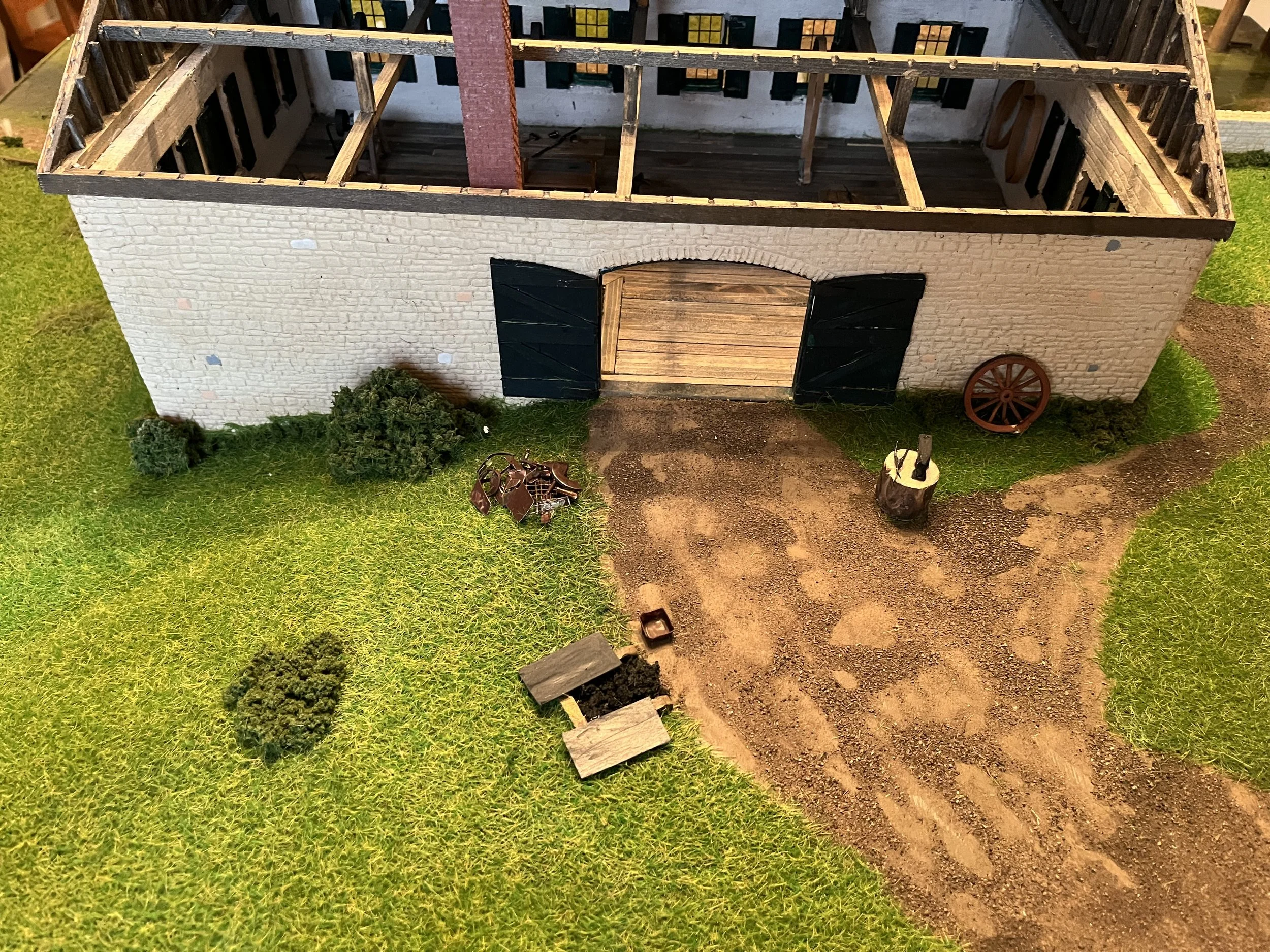
An architectural model of the shop as it appeared when built, with its mill race and water wheel. See how the model was made →
The opening of their third shop solidified the Alexander brothers’ presence in the community and was a significant step in its economic development. In addition to their support of commerce, the brothers constructed residences and were instrumental in founding a Methodist congregation. Julius served the church as a trustee and Sunday school superintendent. He was known to be a man of strong faith, decided convictions and eminent Christian character.
The craftsmanship and sturdy construction of their shop are evidenced by the fact that it served a variety of other businesses for nearly 17 decades. Over those years, as ownership of the building passed from one proprietor to another, businesses within its walls included a carriage and wagon shop, a cooperage, a laundry, even an automobile sales and repair shop and, ultimately, a tea room that grew into an iconic, regionally renowned restaurant.
The new shop hadn’t been operating very long when, in 1848, gold was discovered at Sutter’s mill in California. Geneva was not unaffected by the gold strike. “Gold fever” excited many adventurous entrepreneurs, including the Alexander brothers who planned to head west with the “49ers.”
They closed up the blacksmith shop, but ultimately only Edward left for California. It’s not known exactly why Julius decided to stay behind. He opened yet another blacksmith shop on the west side of the Fox River at the foot of Hamilton Street.
Edward eventually returned to Geneva, apparently without hoped-for riches, and settled into a quiet farming life south of town. Both men remained pillars of the community, living into their 70s. They were buried in the city’s West Side Cemetery.
The Gold Rush
As the years passed, the appearance and use of the Alexander brothers’ shop underwent numerous transformations, evolving along with the needs of the community. Its location on a highly trafficked road and its ease of adaptability encouraged a sequence of tenants including:
A Chameleon Structure
1854
Rystrom Carriage and Wagon Shop
1882
C. E. Mann Cooperage barrel manufacturing
1892
Excelsior Laundry
1902
Updike Carriage, Buggy and Wagon Shop
1923
Lundeen Garage automobile sales and repair shop
1929
Tallman plumbing and heating
Examples of the structural modifications and other changes during these years include:
A wood-framed second floor was added above the original limestone walls in the early 1860s by proprietor John Rystrom, a blacksmith by trade who at age 33 emigrated to Geneva from Sweden. Consequently, the original gabled roof was removed and replaced, and heavy timber posts and beams supported the floor for the second story where carriages were upholstered and painted. An inclined ramp, rising to the new second story from State Street, allowed for the movement of carriages from one level to the other.
The C. E. Mann Cooperage from 1882 became known for manufacturing not only wooden barrels but also other wood products such as cheese and butter boxes, and a patented potato planter. Prior to opening the cooperage, proprietor Clyde Mann resigned his position as Kane County superintendent of schools and a principal in Geneva schools. In 1874, he had been instrumental in establishing the first high school in Geneva.
A fire in 1891 destroyed the second floor. With only the limestone walls standing after the fire, the structure for a while was not suitable for business operations.
In mid-1892, the building was rehabilitated. A new shed roof, sloping north to south, returned the structure to a one-story building.
A new concrete bridge for State Street over the Fox River was built in 1909 and 1910. The new approach to the bridge from the east significantly obstructed the front (north) façade of the limestone building. In fact, every time a new bridge was built over the river and its mill race, the grade in front of the shop was lengthened and raised. After the 1910 major grade change, the large doorway on the east elevation of the building became its primary access point.
By 1921, the mill race between the west side of the building and the river had begun to naturally fill in with soil.
To accommodate an automotive sales and repair business in 1923, the structure’s ground floor, likely wooden planks over a heavy timber frame, was replaced with a cast-in-place concrete floor to support the weight of the vehicles.
The kinds of businesses occupying the structure evolved with the community – from light industry and agricultural services to traveler services, prompted by the city’s location on the Chicago & North Western Railroad and the transcontinental Lincoln Highway. The mills and manufacturing along the river banks began to disappear, and automobile filling stations and restaurants proliferated.
Without doubt, the most consequential change in the use of the Alexander brothers’ building came in 1933. Proprietor Anne Forsyth revitalized the structure and transformed it into the Mill Race Inn, a seasonal tea room that over the next seven decades would become a beloved local restaurant.
Anne, 58 at the time, was an unmarried resident of Aurora who had worked in a variety of clerical positions before becoming a police woman in that city. Assisted by her sister Margaret (Marjori), Anne opened the café on May 23 for “lunch, tea, dinner and supper.”
Because the building was not centrally heated or cooled, the restaurant for many years operated between mid-April and early November. The only source of heat was a fireplace that Anne had constructed on the east wall of the dining room when the building was remodeled to become a restaurant.
An advertising flyer distributed for the new restaurant stated:
The Mill Race Inn
The Mill Race Inn, a new restaurant, now open for lunch, tea and dinner is at the water’s edge of the Fox River, and has two real charms of the old world inns: good food and attractive setting.
Anne Forsyth, Owner
The cooks and staff for the restaurant were mostly Swedish women of Geneva. Cocktails were served beginning after the end of Prohibition that December.
Anne’s vision and hard work breathed new life into the old limestone structure, drawing patrons to its quaint charm and riverside views. Under her stewardship, the business became a cornerstone of the community, embodying its spirit of hospitality.
When Anne opened her business, it was in rented space. In 1939, she purchased the property.
In the early 1940s, renovations and structural additions were completed, including a new kitchen attached to the northeast corner of the original limestone building, and a pavilion and open-air screened porch on the south side. After World War II, the cozy atmosphere began to give way to an ever-larger restaurant with an expanding customer base. The original historic limestone shop, no longer visible from the outside, became the restaurant’s “Stone Room.”
After 1946, Anne Forsyth, then 71 years of age, began cutting back on daily management and operation of the restaurant. She sold the property to the Mill Race Inn, Inc., in which she was a director.
Periodically over the years, other changes and additions accommodated a growing clientele. Each alteration, accomplished for modernization, contributed to the rich tapestry of the building’s history. A dining porch facing the Fox River was added to the restaurant’s west side. Interestingly, the beams for the porch were salvaged streetcar rails. During the war, many communities had pulled up streetcar rails to provide scrap metal for the war effort. After the war ended, leftover scrapped rails were no longer in demand.
In the 1950s, the restaurant continued to operate seasonally, from mid-March to November. Although the restaurant was winterized in 1960 for year-round operation, the owners continued the tradition of closing several months during the winter.
By 1964, the remnants of the mill race along the west side of the restaurant vanished as it was filled in by the State of Illinois. Three years later, a reception area and waiting room were added to the restaurant, further enveloping and burying the historic limestone blacksmith shop.
In 1976, five months after her 100th birthday, Ann Forsyth passed away.
The Mill Race Inn restaurant continued to serve customers and thrive, becoming almost synonymous with Geneva. It was not only a destination restaurant along the Fox River, but also a place remembered locally for celebrations like graduations, weddings and anniversaries. It didn’t hurt that the complex was rumored to have at its core the mysterious remnant of a blacksmith shop dating to the earliest years of the community.
Expansion and Growth
Yet business began to sputter, and finances became more difficult in the early years of the new century. Its customer tastes and owners changed. Management said that the facility’s small dining rooms made it difficult to host large groups. There was a proposal to add a lower-level dining room, but it failed to achieve building code approval because the restaurant was located in the river’s floodplain. The property had experienced flooding several times over the years, and flood damage had added to the building’s structural burden. The plans for expansion were abandoned.
Then, on Thursday, January 20, 2011, the closure of the Mill Race Inn was announced for the following weekend. After serving customers for nearly eight decades, the news came as a shock to the community. Many thought that surely someone would purchase and reopen the restaurant, but it was to stand vacant for the next six years. Deterioration accelerated.
Decline and Closure
In 2014, the Mill Race Inn property was purchased by the Shodeen Family Foundation, affiliated with the Shodeen Group, a Geneva-based real estate developer and builder. The purchase price for the riverfront site was $550,000.
At the time of purchase, the developer publicly expressed a commitment to evaluating the original 1840s limestone core to see if it could be salvaged. But ultimately, the owner decided that costs made preservation and reuse unreasonable.
In August 2016, the developer petitioned the city to demolish the restaurant, stating that renovation and restoration were not economically reasonable. The city issued a permit for the restaurant to be torn down, but the permission was conditional. The property owner was required to spare the historic building that historical records documented was hidden inside.
After months of suspense about the size, appearance, and condition of the embedded structure, answers came in September 2017 when the Mill Race Inn sections constructed after 1933 were peeled away.
Conditional Demolition
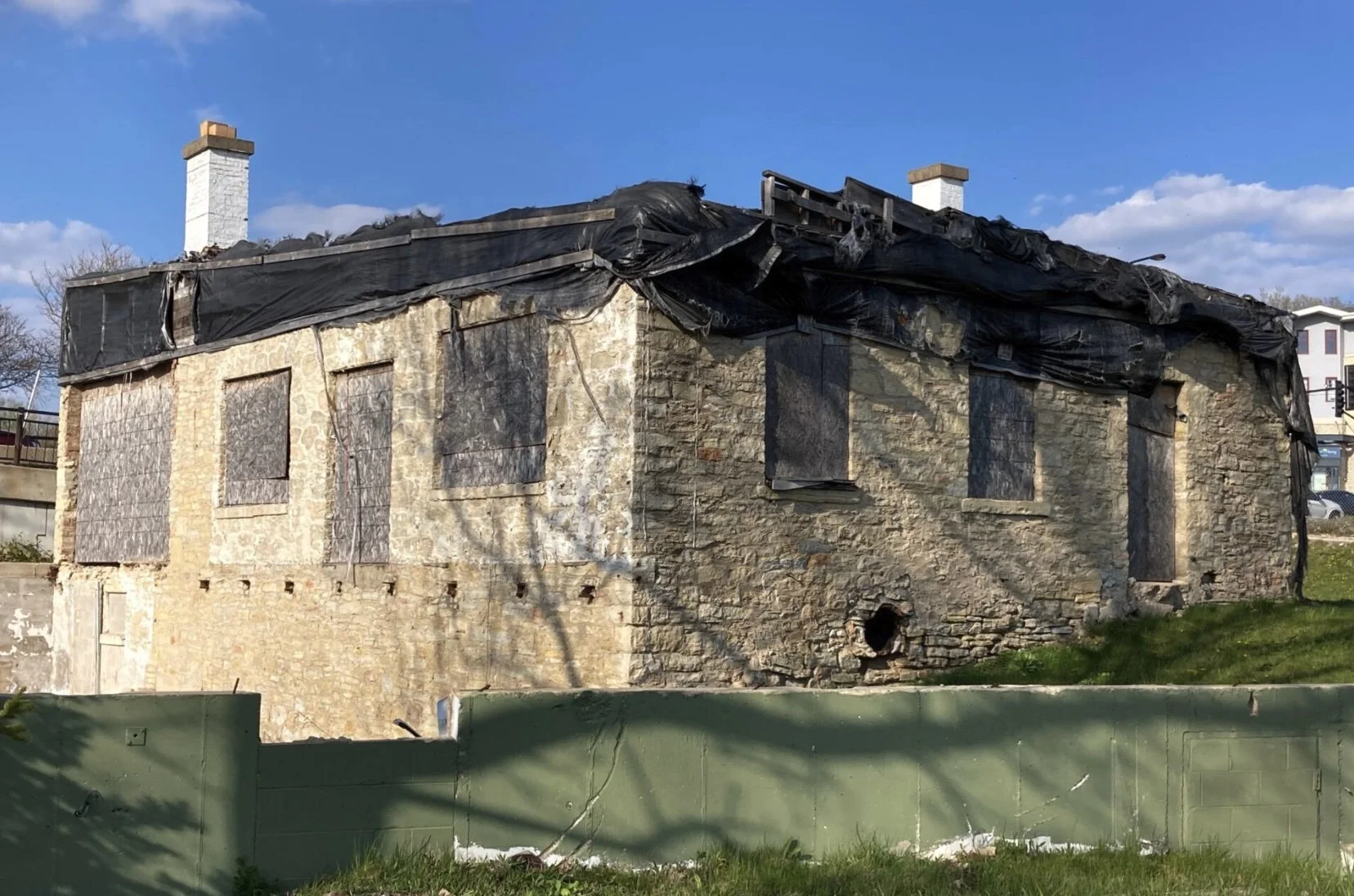
The limestone walls, visible again for the first time in decades.
The remains of the blacksmith shop retained enough integrity so that today’s visitors can discern its original purpose and see the craftsmanship of the two Alexander brothers. Yet without the happenstance of being ”buried” in the Mill Race Inn restaurant for all those years, the building assuredly would have been torn down and not survived into the 21st century.
In December 2017, the developer submitted a petition to demolish the remaining limestone core, claiming remediation of the historic structure and the site was economically unreasonable. That request prompted local citizens to nominate the structure for landmark status. To protect the site, the city in May 2018 officially designated the Alexander brothers’ shop a local Historic Landmark, which effectively denied the demolition request.
That same year, Landmarks Illinois, a statewide organization for preservation advocacy, identified the Alexander brothers’ blacksmith shop as one of the state’s Ten Most Endangered Historic Properties.
At a public meeting in June 2019, the developer presented a plan and architectural renderings for redevelopment of the Mill Race Inn property. It showed a six-story, mixed-use building that included 116 residential units, 8 townhouses, 2,000 square feet of commercial space, and 155 covered parking spaces. The plan was not well received by the audience.
In the following years, the developer submitted second and third petitions for demolition. A request in 2022 included de-designation of the Historic Landmark status. The City Council voted to deny both the de-designation and the demolition requests. In 2025, another demolition petition, substantially similar to previous requests, was submitted, but the City Council, by a narrow vote, again denied the application.
Recurring Demolition Threats
The Geneva community has a long history of embracing its historic places. Much of the downtown and surrounding residential blocks are recognized on the National Register of Historic Places. Local pride of place is evidenced by its well-maintained houses and businesses throughout the community and a vibrant downtown.
The Alexander brothers’ blacksmith shop is a cultural resource that is a prominent part of the community’s narrative. The humble building, both ordinary and extraordinary, has evolved with the community’s changing tides of commerce, from agriculture to industry to hospitality.
As the community now grapples with the future of the building, proponents of preservation proclaim that the building represents the inspiring stories of early settlers and the spirit of resilience that has defined Geneva for nearly two centuries. No other pre-Civil War water-powered industrial buildings exist along the Fox River for the 50 miles south to Ottawa where it empties into the Illinois River.
The Alexander brothers’ shop is a gift from the past – not a burden, but an opportunity. With stabilization, restoration and adaptive re-use, the building that has stood for 18 decades can be appreciated even more 18 decades from now.