In His Own Words
Autobiographical Comments by
Julius Tozer Alexander
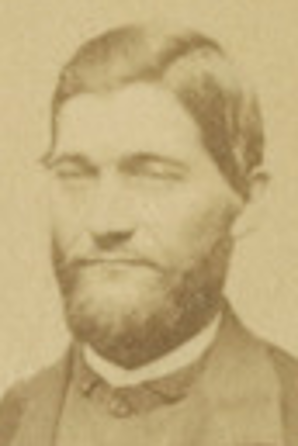
Julius Alexander was born on September 2, 1814, in St Clair County, Illinois, on his father’s farm, one mile east of the village of Shiloh. In his own words, recorded later in life, he recalled his trade, the town and the shop he helped build.
Childhood and the Black Hawk War
I remember going to school with my older brother Edwin at Shiloh, where Mother taught the school. This was about 1820 when I was 6 years old.
Mother died August 24th, 1820. I quit going to school when 14 years of age. From 10 to 14, all the schooling obtained was about three months in the winter. In summer I plowed with an ox team with brother Edward. Graduated from grammar school in a 40-day course when 15 years old.
From then until I was nearly 18 years old, I worked on Father’s farm. In the spring of 1832, I volunteered with the Illinois militia in the Black Hawk War, and in the war for 90 days. Had no uniform, and every man had his own outfit. Father furnished a good horse, black, named “Cuff.” Had a smooth-bore rifle, flint lock, saddle bags over my saddle, cow’s horn powder flask and shot pouch of deer skin. There were 1,500 men. Colonel Buckmaster and General [Samuel] Whiteside had charge. Abraham Lincoln was another captain in the same corps.
Captain Moore was my uncle, having married Father’s sister. The company was organized at Belleville and went to the general rendezvous at Beardstown on the Illinois River. We were there about two days, then went northwesterly to Rock Island, where the next day we started up the valley of the Rock River, keeping on the south side of the river all the way to Dixon. On this trip we found several Indian villages from which the Indians had fled. We burned the wigwams, which were mostly constructed of poles and bark. The Indians had cached a great deal of dried venison, corn, maple sugar, and beans. At one place we found 500 pounds of maple sugar.
The regular troops had flat boats loaded with supplies which they towed up the river. When the regiment reached Dixon, we found that Illinois Governor John Reynolds (who also was a major general in the state’s militia) was just starting up the valley of the Rock River on the east side, about 30 miles, to capture Black Hawk and his men, but on May 13th when they got to Stillman’s Run (now so called), they were surprised while in camp the next night. The men were in panic and fled towards Dixon, leaving everything behind, and got into Dixon at 11 o’clock at night.
I was on guard that night, and the first man that came in said he was the only man who escaped. The next morning, at daylight, we started on a forced march for the scene of the battle, and met men all the way along, some wounded, some two on a horse, and all demoralized. When we got to the battlefield, we found nine men killed, and the camp wagon plundered of all valuables and the spokes chopped so that the wagon could not be used.
It was about 4 p.m. when we reached there, and after burying the dead, formed a line of battle, sending scouts ahead to see about the position of the Indians. None could be found, however, so we pitched our tents and camped for the night. We returned to Dixon the next day, as we had no provisions to enable us to continue the pursuit. All we had was beef from a lot of old oxen taken from Dixon, the Indian trader, and corn which we parched. We also had no coffee and sugar.
When we got back to Dixon, we found the regulars had arrived with the supplies. We were at Dixon a week. Then we started on the home trip, as our 90 days was nearly up. We went across country to Ottawa, striking the Fox River 20 miles above the mouth. We crossed the river at Jesse Walker’s Mission, and went to Holderman’s Grove in Kendall County, and found the settlement deserted. All had fled, leaving everything.
We followed down the Fox to Ottawa. The day before we got there, the Indians had made a raid on the Indian Creek settlement and killed several people, and took two sisters, called the Hall sisters, prisoners. They were detained until the Indians were subdued, when they were released and returned to their home.
We forded the Illinois River at the mouth of the Fox River, and went to the new fort just constructed on the south side. Here we were discharged, and many, my uncle and myself included, returned home.
Our service included four or five days to go Belleville to Beardstown. Beardstown to Rock Island, a month. Rock Island to Dixon, two or three days. Dixon to Ottawa, about one week. (Took 21 Indians prisoners at Big Swamp.) Got home in August.
Learning the Blacksmith’s Trade in St. Louis
In September or October, 1832, I went to St. Louis to learn the blacksmith’s trade with brother Edward. The first employer was Newel, Gaty and Koontz, general blacksmiths, machinists and boiler makers. They employed from 200 to 300 men and had about 30 apprentice boys. My older brother Edward went to St. Louis first. Father wanted him to learn a trade, and that firm was well known. I went because my brother was there and our object was to learn the trade and then go to some good locality and go into business together. Ed had been there about two years when I went there.
For the first two years, all I did was to blow the bellows and strike, acting as helper. There were 13 forges going in the shop. There were no power blowers or trip hammers.
Had one forge that was supplied with a crane. One forge was used by a French negro who made nothing but traps for the trappers of the east, and squaw axes and hunters’ knives. His name was Mike. Another negro, Anderson by name, used to make mill irons. I worked with him a good deal. He was a slave and got $2.50 per day, and finally bought his freedom. A Kentuckian, named John Davis, made edged tools, axes, broad axes, etc. Others forged irons for engines. Also made bolts and nuts. All was done by hand.
The last year I had a forge myself. First made boiler rivets, then made 300 log chains for Subletts Brothers, trappers in the Rocky Mountains. Also made bolts and various other things. Worked one year as a journeyman. Got $18 per month and board and washing. The company had a large boarding house adjoining the shop. Mrs. Newel was the landlady.
For breakfast, we had coffee, beefsteak, potatoes, bread and butter, and sauce. Dinner, roast beef, potatoes, cabbage, bread and butter, and pudding or pie. Supper, bread and butter, sauce, and tea. The cooking was generally well done, and they also did our washing. The first month I got my first money, $18. I kept most of it.
I went to a circus most every night. I played cards, Old Sledge was the game. I also played Ten Pins. Remember making a “10 strike” once, and won a watch worth $3. Very seldom went to church. Generally went hunting over the river or loafing around town. Never drank beer or whisky. Learned to chew tobacco when I was 16 years old.
“The next day after we returned to Geneva, we set to work and cut trees and built a log shop, about one block north and east of the bridge.”
When we left St. Louis, we had $100 between us. We bought some clothes and cheese and crackers, and got on the Jo Davis steamer riverboat that came to Ottawa. Took deck passage and paid $5 for each fare. Slept on the deck. We were about three days on the way. Then we took a stage from Ottawa to the Des Plaines River. (Noah Spaulding was the stage driver.) Stopped at Doty’s Hotel, about four miles below where Father was living. There was an Indian trail and we went up on foot to Father’s farm on the east side of the Des Plaines River, 10 miles west of Chicago. The place is now called River Forest. This was in September 1838.
Years earlier, in 1836, Father had sold his farm down in St. Clair County. Six hundred forty acres at $12.50 per acre, cash, all in silver, 5 franc pieces, $8,000. He moved north in a prairie schooner, drawn by four yokes of oxen, and settled in Plainfield. Bought a farm of 640 acres.
Then in the fall he went to Des Plaines. George E. Walker and Father bought a mill property of John Noble, also 320 acres of land. There was a saw mill there, sash saw, and they built a flour mill. They first built a dam which backed the water up 12 miles, so much head that it gave way and was all swept away. Then they raised the saw mill up and put in a steam engine between the saw mill and the grist mill. Before this, Ed and I started a blacksmith shop and worked there all fall and winter making the iron work for the mill mentioned above.
Father and George Walker sold their property to the Chicago & Galena Railroad Company, and Father took his half, $6,500, and invested it in a bakery, about two or three blocks east of Wells Street, on the north side of the Chicago River, known as the City Bakery. Steel was the man’s name who sold him the bakery. Father rented it to a baker for $800 per year, and my brother Henry learned the baker’s trade there. A defect in the title caused Father to lose the place as a mortgage, as prior lien held the place. Steel had failed, so no recourse could be had on him. Father afterwards met Steel, and Steel persuaded him to give a release for two pounds of tobacco. When Father had chewed that all up, he quit the use of the weed forever.
Ed and I moved to Geneva, arriving there July 1st, 1837. Came with wagon and oxen, bringing tools and a little iron and steel. The next morning after we reached Geneva, we turned the oxen out to graze and started on foot for Plainfield, 25 miles distant, to spend the Fourth of July. Took nearly all day following an old Indian trail. Went barefooted a good part of the way as there were creeks and sloughs to cross. Some of the folks brought us back with a team of horses.
The next day after we returned to Geneva, we set to work and cut trees and built a log shop, about one block north and east of the bridge. It was all timber or forest there at the time. Made shakes of oak timber to cover the roof with.
Then we quarried stone a little east of the shop to build a forge and chimney with. Had the natural ground for the floor. Then we cut more trees and made a charcoal kiln and burned the coal we used. By the time the coal was ready, we had our bellows up, anvil and bench all in shape, so we were ready for work.
Our first job was for Daniels, Stroade, Sterling & Co., who owned the water privileges here, and who were owners of the saw mill. We made the iron work for the mill, amounting to about $400. The first payment of $100 was in notes from a bank in Coldwater, Michigan. We took the money to Chicago and bought iron and steel. In a day or two it was found that these bank notes were worthless. A narrow escape.
1837 was the year of the panic. Banks failed, and there was no money in the country, and we were obliged to take produce in exchange for work. What little money we received was carefully saved to buy material.
We first boarded with Jim Brown who kept the hotel at the old Rathbone House. Then we boarded with James Hotchkiss. This hotel is where Webster afterwards kept a hotel. In the spring of 1838 we built a house, the next one west of the Lester place. Afterwards two “wings” were added to this house. We kept “bachelor’s hall” at this place, Dick Adsit, Robert Lester, brother and I. Lived this way till the next June, when the Chambers family moved in and stayed about a month. Then they moved onto their farm, except the Medaws who remained till the next spring when they moved into a house across the street, which they had built.
We again kept “bach” till I was married in November 1839. While we kept bach, we took turns cooking; generally had pancakes, coffee, potatoes, molasses, pork, etc., in the summer corn cakes, and in the winter, buckwheat. Had the old Franklin cook stove with two boiling places. For dinner we usually had about the same, meat and potatoes.
Went to work at sunrise and quit work at sundown. In the evenings we would come over the river and loaf at the stores till bedtime, and then go back home and to bed. Had a foot bridge across the river a little north of the present bridge. When winter came, we took out the foot bridge and crossed the river at the dam.
At this time, there were living in Geneva James Herrington, the first settler, Samuel Sterling, James Brown, James Hotchkiss, Peter Sears, Scotto Clark, Charles Patten, Richard Adsit, Robert Lester, Lyman German, Mark Daniels, and the McKinley family. Fridley was the first sheriff. Mark Fletcher, the first county clerk. The first courthouse was built in the summer of 1838, on the block where Long’s store is now, and the first jail was the next block west, where the Crary place is. It was built of logs and had a common plank door. Prisoners could get out easily, and it never was used but once, and that prisoner got out in an hour or so after being incarcerated. We used to hold church services in the courthouse and schoolhouse.
Arrival in Geneva
Marriage and Life in a New Town
In the summer of 1839, I became acquainted with Miss Wealthy Sikes, who emigrated to this state from Ludlow, Massachusetts, with her sister’s family (Mrs. Aram Cooley). Through the kind offices of Mrs. Bain, a lady who had lately married a widower and who was an “old maid” at the time of her marriage, I made the acquaintance. We were married on Thanksgiving Day, November 28th, 1839, at the residence of Mr. Joseph Worsley near Nelson’s Grove. The house was a one-room log house with an attic. For a wedding trip, we went to Plainfield to see my father and his family. Had a horse and buggy to go with. When we returned, father brought us back and gave us a table now used as a kitchen table, a tub and some tinware, a small feather bed, some liverwurst and fresh pork. After the wedding, Edward returned to Geneva and kept the shop open. Rev. Hiram Warner married us. No cards. Cost was $5.00 to pay the minister. Fletcher, the county clerk, made me a present of the marriage license.
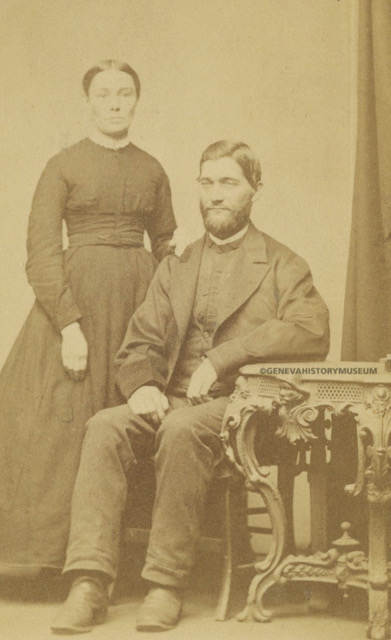
Julius and Wealthy Alexander
(date of photo unknown)
Martin Van Buren was the President from March 4, 1837, to March 4, 1841. I voted for him and was a Democrat. My wife was an abolitionist and Wig and supposed I was an abolitionist. She was greatly disgusted to find I was a Democrat. I took no paper, had very few books and read little, if any. When we were not working evenings, I went uptown and passed the evening with other men of the town talking over the local affairs.
David Dunham’s store was the loafing place. His store was where Lance keeps store now. At the time, Pindar Ward was a little curly-headed boy acting as clerk. Dunham sold whisky as he would molasses or sugar. He was also county clerk and kept the records in his store. Used to write up his books on Sunday. During 1840, the Presidential election took place, and William Harrison was elected. I voted for Van Buren again, but he was defeated. The town did not improve much during these years, as times were dull.
In 1842 we had the land sale, and I deeded from the government the quarter section on the east side of the river. The patent was issued to me, and I deeded it to the several owners afterwards. This sale was in Chicago. Before I entered the land, the “squatters” quit-claimed to me. See deed dated May 18th, 1842, signed by James Brown, William R. Power, Samuel Sterling, Charity Harrinton, George McKionley, Peter Sears, Jarvis S. Danford, Ezra Gilbert, Edward Alexander, Robert Lester, Lyman German and Horace B. Miller. Description: S.W. Sec. 2, T. 39N, R. 8 E., 3rd Principal Meridian. Patent issued March 10th. 1843, on certificate 10156. 135.68 acres at $1.25 — $169.60. There was a large crowd of us went to Chicago to attend the sale. It was an auction sale, and the understanding was that the ones agreed on should bid in the land at $1.25 and get the land.
We stopped at the Sanganash Hotel. The money was all in gold and silver in a bag, and I carried it in my pocket. It was about this time that fleas were introduced into the country. Bedbugs were old settlers, however. The sale was in August 1842. Dunham had surveyed out the town before this.
In 1844, there was a Presidential election resulting in the election of James Polk and George Dallas. The Mexican War was in 1847. A company for this war was organized here, and Lew Norton was elected captain.
These autobiographical comments are archived in the Geneva History Museum in Geneva, Illinois. Julius Tozer Alexander died on January 22, 1889, at the age of 74. He was survived by his wife, Wealthy (1820-1905). They had a son, Hugh W., who died in infancy in 1840; a son, Edward Wright Alexander (1842-1911); and a son, Hugh Byron Alexander (1847-1930). Julius’ brother, Edward R. Alexander, died in 1892 at the age of 75 or 76. The family is buried in the West Side Cemetery in Geneva.